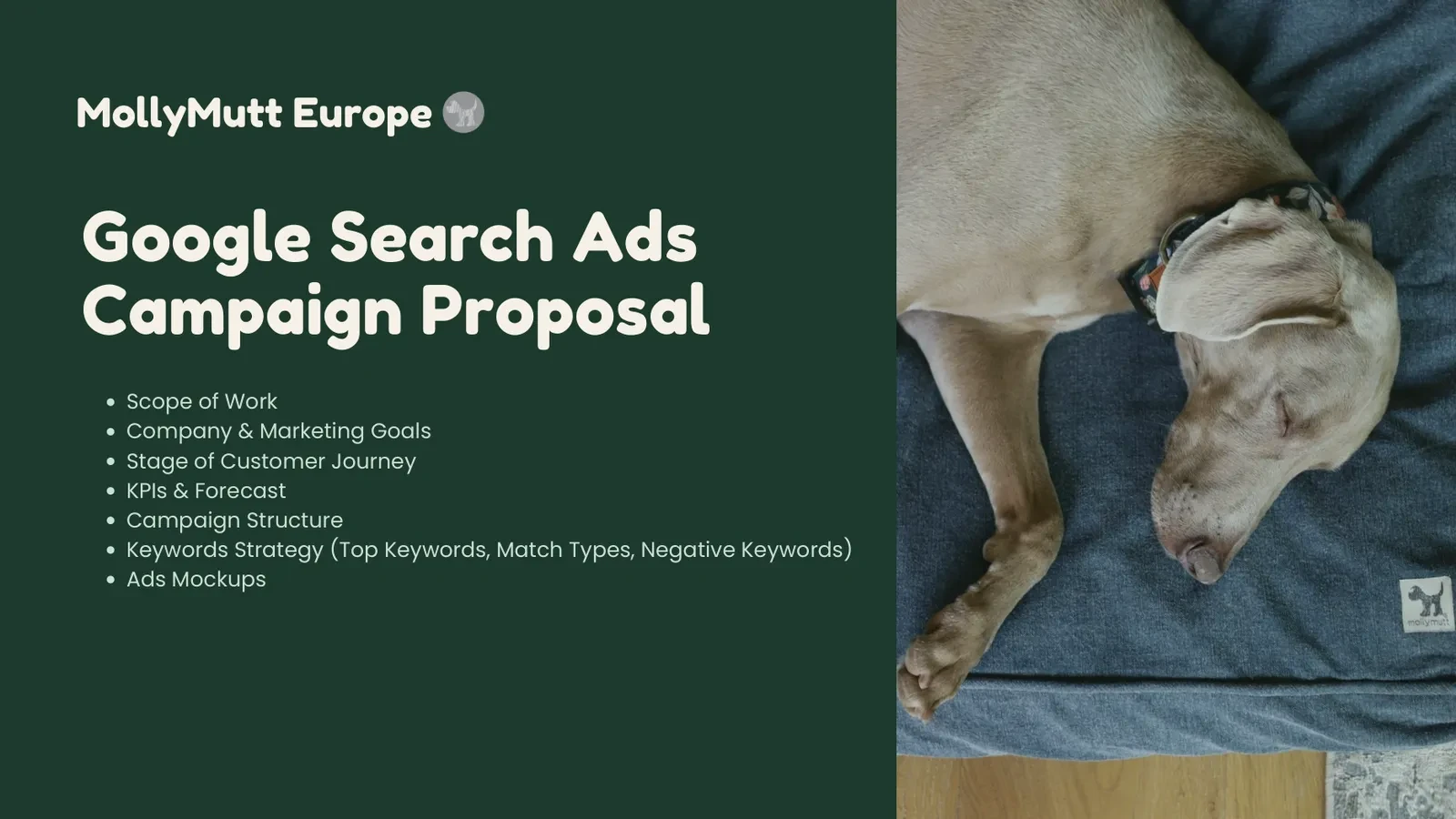
Molly Mutt Europe — Google Search
Can €60 teach us something real? A Search campaign plan for washable, sustainable dog bed covers in Germany: keyword research, two ad groups, responsive search ads, sitelinks and negative keywords.
- My role
- Keyword research (match types, negative keywords), budget plan and forecast
- Team
- 4 DCI students
- Status
- Draft in Google Ads, not launched
01Project overview
A Google Search campaign proposal for Molly Mutt Europe, built as a DCI group assignment with a hypothetical €60 budget over six days. The campaign was set up as a draft in Google Ads and never launched. No money was spent and no clicks were recorded.
What this project shows is the reasoning: how to scope a tiny budget so that the data it buys can be interpreted.
02Business challenge
Dog beds are a competitive search category in Germany. With €60, a broad campaign would spend the budget on loosely related clicks before anyone could learn anything. The proposal had to stay narrow enough to produce a readable first data set.
03Target audience
- German-speaking dog owners in Germany
- In the consideration stage: they know they need a better bed and are comparing washable or eco options
- They type searches like “hundebett bezug waschbar” or “ökologisches hundebett” — commercial intent, close to buying
04Campaign objective
Website traffic. Attract relevant German-speaking visitors to the dog bed cover product page, and collect first German search data (search terms, CTR, CPC) to plan the next campaign. Bid strategy: Maximize Clicks.
05Strategy and approach
- One market, one product, one message: Germany only, dog bed covers only, German keywords.
- One campaign with two ad groups that match the brand’s positioning: sustainable/eco dog beds, and washable covers.
- Exact match for the low-volume sustainability searches so every click is on-brand; phrase match for the higher-volume washable searches.
- Broad match deliberately left out until conversion data and strong negative keywords exist.
- Negative keywords for price hunters, competitor platforms, second-hand intent and the wrong product type (orthopaedic, memory foam).
- Responsive search ads with 15 headlines and 4 descriptions per ad group, plus callouts, structured snippets and six sitelinks.
06My individual contribution
- Researched search intent in Google Keyword Planner and selected the German keywords and match types.
- Built the negative keyword list to keep the small budget away from irrelevant searches.
- Planned the €60 budget and prepared the forecast for clicks, CTR and cost per click.
- Worked in a team of four DCI students; we shared the campaign structure, ad copy and presentation.
07Creative samples and screenshots
Scope: one market, one product, one message Targeting the consideration stage One campaign, two ad groups Keyword research from Google Keyword Planner Match types chosen to protect a small budget Negative keywords Ad mockup, ad group 1: sustainable dog beds Ad mockup, ad group 2: washable covers Keyword Planner forecast (30 Sept 2026)
Documents
08Tools used
09KPIs
Forecast and targets — not results
- Proposed budget, €10 a day for 6 days
- €60
- Forecast clicks (target ≥ 62)
- ~62
- Forecast CTR (target ≥ 4%)
- ~4.2%
- Forecast avg. CPC (target ≤ €1.00)
- ~€0.97
- Forecast impressions
- ~1,500
All figures are planning estimates from Google Keyword Planner, retrieved 30 Sept 2026. No ads ran, no budget was spent and no clicks or conversions were recorded.
10Key learnings
- Intent beats volume. A keyword can have strong search volume and still be a poor fit for the product.
- Small budgets force priorities. Scope, match types and exclusions should all serve one learning objective.
- Forecasts are hypotheses. Only a live campaign with reliable tracking can confirm them.
Want to talk about this project?
I’m happy to walk you through the thinking behind it.